Walk into any gymnastics club, physical therapy clinic, or old-school European gym and you'll almost certainly spot one mounted to the wall. Yet most people building a home gym have never even heard of it. That's starting to change — and once you understand what a Swedish ladder actually does, it's hard to justify leaving it out.
A quick bit of history
The Swedish ladder — also called a stall bar, wall bar, or ribstall — was invented in the early 1800s by Pehr Henrik Ling, a Swedish gymnastics teacher who wanted a simple, versatile piece of equipment that could train the whole body without taking up floor space. Schools across Scandinavia and Central Europe installed them by the thousands. They became a staple of physical education for over a century before modern gym machines slowly pushed them out of the mainstream.
The irony is that everything those expensive cable machines and pulley systems try to do, a Swedish ladder does better — with nothing but wood, wall anchors, and your own body weight.
So what does it actually do?
At first glance it looks almost too simple. It's a wooden frame, usually around 80 cm wide and 220 cm tall, with evenly spaced rungs mounted flat against a wall. No cables, no weight stacks, no moving parts. And yet the range of exercises it supports is genuinely impressive.
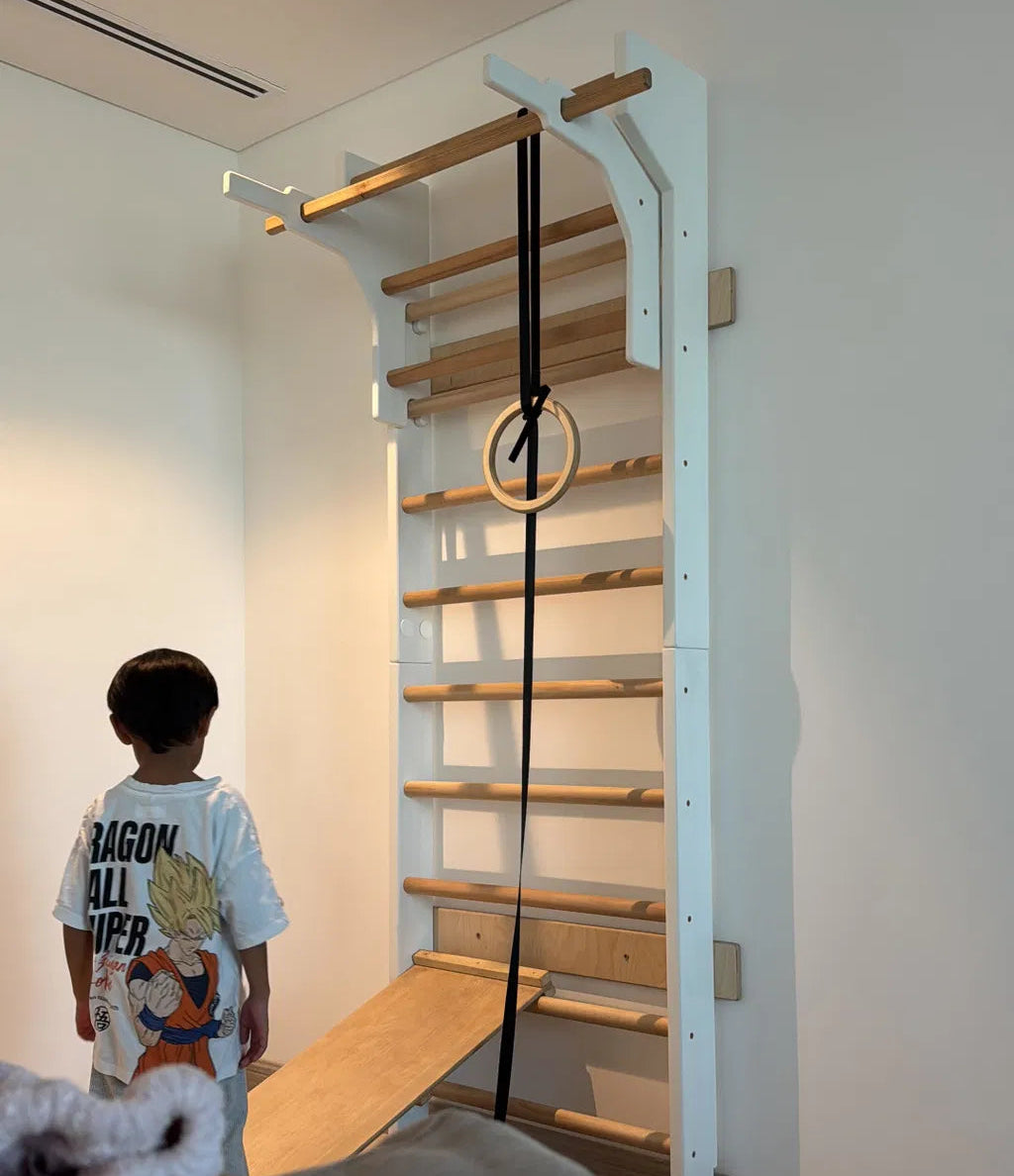
With a basic Swedish ladder you can do pull-ups and chin-ups, hanging leg raises, back stretches, shoulder mobility work, incline push-ups at different angles, balance exercises, and deep spinal decompressions. Add a pull-up bar and dip bars — which attach directly to the rungs — and you've got a full upper-body training station. Add gymnastic rings, a rope, or a climbing net and it becomes a complete home gym setup that would otherwise require four or five separate pieces of equipment.
For kids, it's a climbing frame, a play structure, and a coordination trainer all in one. We've had customers tell us their children spend an hour a day on it without being asked. That's not marketing — that's just what happens when you put something climbable at the right height in a room.
A quality Swedish ladder holds around 130 kg (300 lbs) for adults and is completely safe for children when wall-mounted correctly. The mounting process is straightforward — if you can hang a TV bracket, you can install one of these.
How it compares to a pull-up bar or a cable machine
A doorframe pull-up bar does one thing. It's fine, but you'll outgrow it fast, and if you ever want to do anything other than pull-ups you're out of luck. A cable machine is expensive, takes up a lot of floor space, and focuses primarily on isolated movements rather than full-body compound work.
A Swedish ladder occupies maybe 80 cm of wall width and zero floor space. It scales with you — the same frame that a beginner uses for assisted stretches and incline push-ups becomes an advanced training tool as your strength improves. You add attachments as you go. Nothing becomes obsolete.
It's also the only piece of gym equipment we can think of that works equally well for a 6-year-old and a 40-year-old. That matters a lot if you're buying for a family home rather than a dedicated training space.
What to look for when buying one
Not all Swedish ladders are the same. The most important factor is the wood — you want solid hardwood or high-grade pine, not laminate or MDF. The rungs should feel smooth and even, with no rough spots that would cause blisters during extended use. Check the load rating. Anything below 100 kg is not designed for adult use.
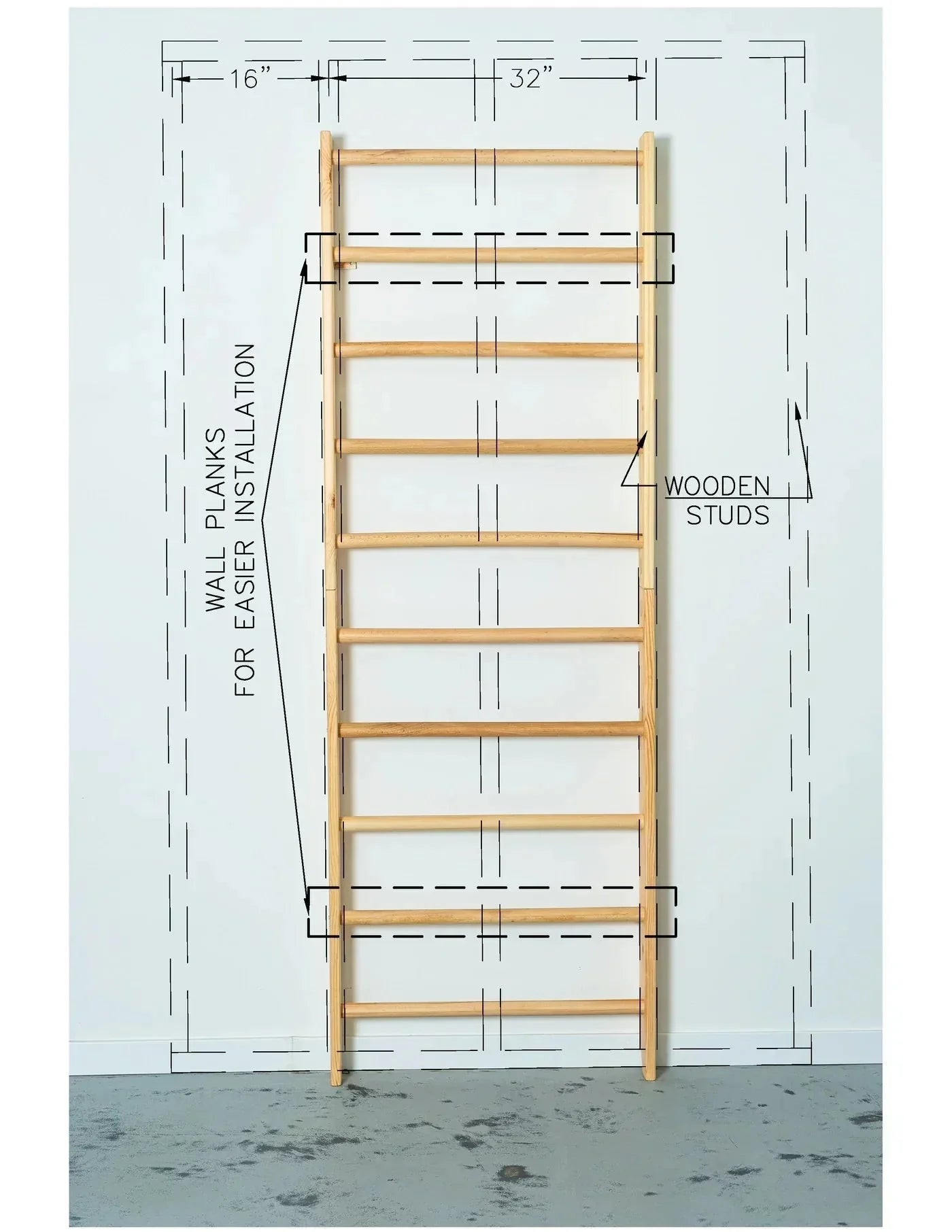
The mounting system matters too. Wall anchors should go into studs or use proper wall plugs — not just drywall. A good Swedish ladder comes with a complete mounting kit including the brackets, screws, and dowels you'll need, plus clear instructions. If those aren't included, factor in the extra cost.
Finally, think about what attachments you actually want. A fixed pull-up bar is more rigid and better for strength work. An adjustable one lets you change the height as your training evolves. Dip bars are worth having from the start if you're doing any upper-body work. A mounting plank is useful if your wall studs don't land in convenient spots.
Is it hard to install?
Honestly, no. Most customers assemble and install ours in about an hour, often on their own. The main steps are locating your wall studs, drilling the anchor holes at the right height, attaching the mounting brackets, and hanging the frame. The full instructions are included, and the hardware is all there — you just need a drill, a level, and some patience with the stud finder.
One tip from customers who've done it: install it slightly higher than you think you want it. You'll appreciate the extra overhead clearance once you start hanging from the top rungs.
If you've been putting together a home gym piece by piece, the Swedish ladder is one of those rare purchases that doesn't feel like a compromise. It does a lot, lasts for decades, looks good in a room, and both you and your kids will actually use it. That combination is harder to find than you'd think.
Browse our full range of wooden Swedish ladders — all with free worldwide shipping and a 1-year warranty.
Shop Swedish ladders